Swami Vivekananda's Chicago Speech 1893: The Full Story
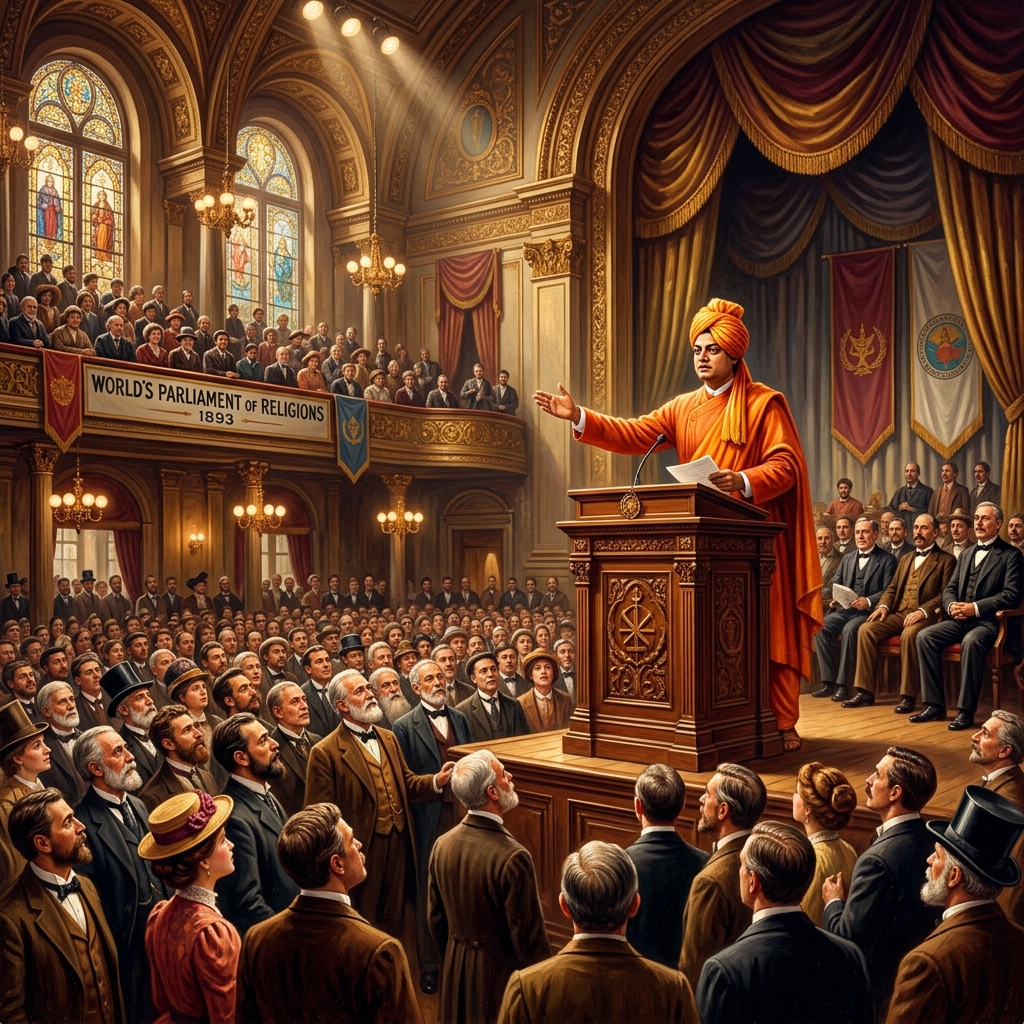
On September 11, 1893, a relatively unknown monk from India stood before an audience of 7,000 people at the Art Institute of Chicago. When he spoke his first five words—"Sisters and Brothers of America"—the crowd rose to its feet in a thunderous, two-minute standing ovation. That monk was Swami Vivekananda, and his speech forever changed how the West viewed India and Hinduism.
The Journey to the Parliament
Swami Vivekananda's presence at the World's Parliament of Religions was nothing short of a miracle. He had traveled to America without an official invitation or credentials representing any recognized religious organization. He arrived in July, months before the Parliament began, facing freezing weather, dwindling funds, and cultural shock.
Stranded in Boston, a stroke of providence connected him with Professor John Henry Wright of Harvard University. After a deep philosophical discussion, Professor Wright was astonished by Vivekananda's brilliance. When Vivekananda mentioned he lacked credentials to speak at the Parliament, Wright famously replied, "To ask for your credentials is like asking the sun to state its right to shine in the heavens." Wright personally wrote to the Parliament organizers, ensuring Vivekananda a seat.
The Historic Speech
The Parliament was a grand assembly of religious leaders from across the globe. When it was Vivekananda's turn to speak on the opening day, he was incredibly nervous. He bowed mentally to the Goddess Saraswati and stepped to the podium.
Unlike other delegates who addressed the audience formally as "Ladies and Gentlemen," Vivekananda began with genuine universal love: "Sisters and Brothers of America."
This simple greeting pierced through the formal, dogmatic atmosphere. It wasn't just rhetoric; it was the pure, lived realization of Vedanta—that all beings are interconnected and divine.
Key Themes of the Speech
- Universal Tolerance: He did not claim Hinduism was the only true religion. Instead, he proudly stated, "I am proud to belong to a religion which has taught the world both tolerance and universal acceptance. We believe not only in universal toleration, but we accept all religions as true."
- The End of Fanaticism: He condemned religious bigotry and sectarianism, stating that sectarianism and fanaticism have long possessed this beautiful earth and drenched it in human blood.
- The Metaphor of the Rivers: Quoting an ancient Sanskrit hymn, he said, "As the different streams having their sources in different places all mingle their water in the sea, so, O Lord, the different paths which men take through different tendencies, various though they appear, crooked or straight, all lead to Thee."
The Aftermath and Legacy
The impact of his speech was seismic. The American press dubbed him the "Cyclonic Monk from India." The *New York Herald* noted, "He is undoubtedly the greatest figure in the Parliament of Religions. After hearing him we feel how foolish it is to send missionaries to this learned nation."
Vivekananda's speech effectively introduced Vedanta and Yoga to the Western world. He stayed in America for several years, lecturing tirelessly, establishing Vedanta Societies, and creating a bridge of mutual respect between East and West.
The Source of His Strength
Vivekananda’s message of universal acceptance was born from the teachings of his Master, Sri Ramakrishna. Explore the birthplace of this profound wisdom.