Swami Vivekananda's Journey to America: The Full Story
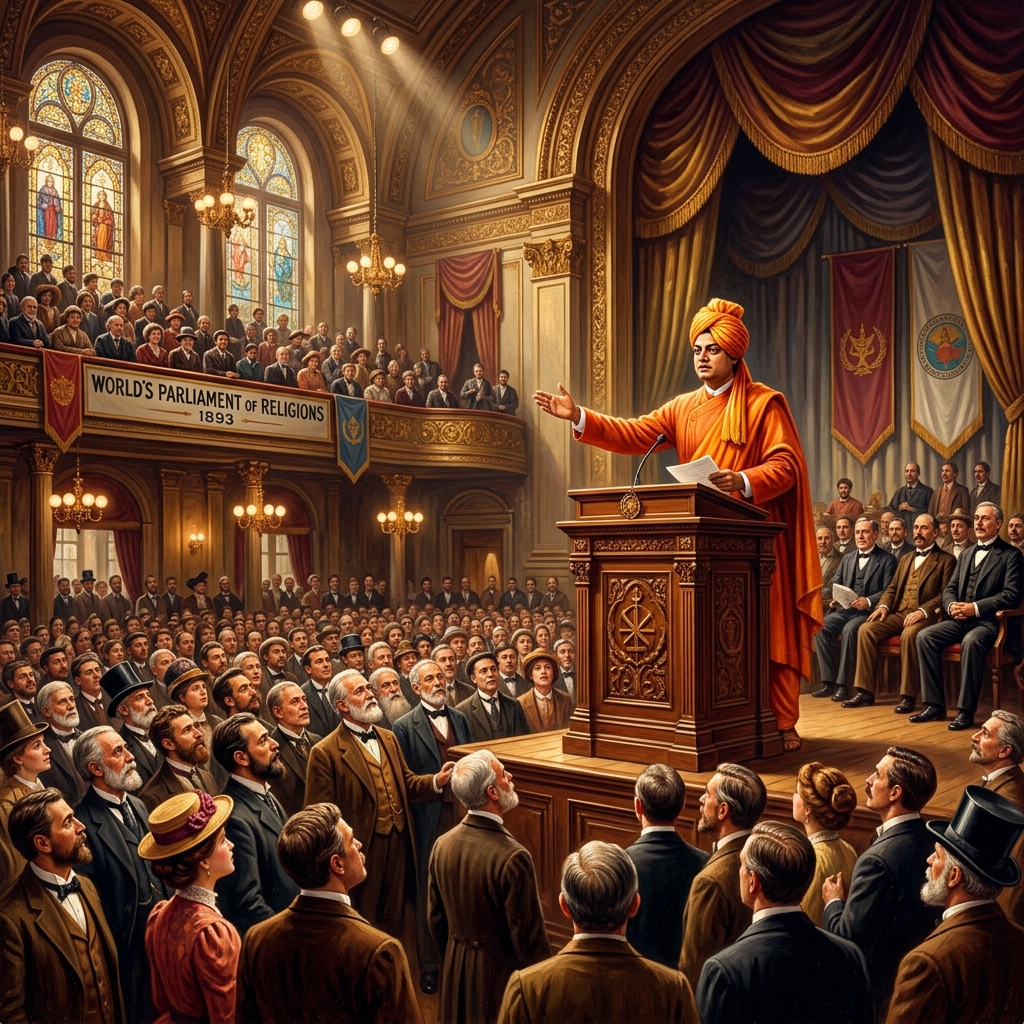
When we think of Swami Vivekananda in America, we immediately picture his triumphant moment at the Parliament of Religions in Chicago. But the journey to that stage was fraught with immense physical hardship, uncertainty, and divine providence. The story of how a penniless Indian monk crossed the oceans to conquer the West is nothing short of an epic adventure.
The Seed of the Idea
After the passing of Sri Ramakrishna, Vivekananda wandered the length and breadth of India as a Parivrajaka (wandering monk). During his travels, he saw the abysmal poverty and degradation of the Indian masses. He realized that India needed material help and scientific education from the West, while the West desperately needed the spiritual wisdom of Vedanta to cure its rampant materialism.
While in South India (Kanyakumari and Madras), his disciples urged him to represent Hinduism at the upcoming World's Parliament of Religions in Chicago in 1893. To confirm if this was the Divine will, he prayed to Sri Ramakrishna and sought the blessings of the Holy Mother, Sri Sarada Devi. Only after receiving her enthusiastic approval did he agree to go.
Funding the Voyage
Vivekananda had no money. The funding for his trip came from young disciples in Madras (now Chennai) who went door-to-door collecting small change. The most significant financial backing came from the Maharaja of Khetri (Ajit Singh), who provided him with a first-class ticket and the iconic orange robes he wore in America. It was also the Maharaja who suggested he formally assume the name "Vivekananda" (Bliss of Discrimination).
The Voyage on the S.S. Peninsular
On May 31, 1893, Swami Vivekananda boarded the S.S. Peninsular from Bombay. He traveled via Colombo, Penang, Singapore, Hong Kong, and Japan (visiting Nagasaki, Kobe, Yokohama, and Tokyo). In Japan, he was deeply impressed by the country's rapid industrialization and patriotism, wishing the Indian youth would learn from them.
From Yokohama, he boarded the RMS Empress of India, crossing the vast Pacific Ocean to reach Vancouver, Canada, in late July. From there, he took a train to Chicago.
Stranded in America
Arriving in Chicago in July, he faced a harsh reality. The Parliament was not scheduled to begin until September. Furthermore, he discovered that he lacked the official credentials required to speak, and the deadline for registration had already passed.
His funds were depleting rapidly in the expensive city of Chicago. Someone advised him that Boston was cheaper. During the train ride to Boston, he met a wealthy lady, Miss Kate Sanborn, who invited him to her home. Through her, he met Professor John Henry Wright of Harvard University. Professor Wright recognized Vivekananda’s genius instantly, bought him a ticket back to Chicago, and wrote to the Parliament organizers ensuring his admittance.
The Final Trial in Chicago
When Vivekananda arrived back in Chicago, he lost Professor Wright's address and the address of the Parliament committee. He spent a freezing night sleeping in a freight boxcar in the railyards.
The next morning, hungry and exhausted, he sat on a sidewalk in a wealthy neighborhood, resigning himself to God's will. Suddenly, a door opened. A lady named Mrs. George W. Hale walked out and asked, "Sir, are you a delegate to the Parliament of Religions?" She took him in, fed him, and personally accompanied him to the offices of the Parliament.
A few days later, on September 11, 1893, he stepped up to the podium and changed history forever.
The Roots of a Global Mission
Before crossing the oceans, Vivekananda gathered his spiritual strength at Dakshineswar and Kamarpukur. Explore these sacred sites.